IRD disclosing unpaid tax
2429POSTED:
1341
Views

Articles by Anthony Strevens.

The IRD have introduced new regulations that allow the Commissioner to disclose information about a taxpayer’s tax debts to approved credit reporting agencies if certain preconditions are met. (These new regulations are found in section 85N of the Tax Administration Act.)
One of these preconditions is that the amount of the taxpayer’s reportable unpaid tax must be greater than the prescribed amount of $150,000, or the debt must overdue by more than a year and is more than 30% of the taxpayer’s gross income. Other conditions include that the Commissioner must have made reasonable efforts to recover the amount, and must have formally notified the taxpayer.
Before the new rule was introduced on April 1 2017, the IRD was obliged to keep information about a taxpayer’s debt secret. The IRD’s reasoning behind changing this rule was that it will benefit both the Crown and the taxpayer’s potential creditors.
• It will benefit the Crown because taxpayers would not want their information disclosed to creditors, so would be more likely to pay their tax bills.
• It will benefit the people taxpayers do business with, as they will be able to find out about any outstanding debt with IRD before entering into commercial transactions. A large debt with IRD would represent increased risk for a business entering into a commercial arrangement, so it is of benefit for it to be disclosed.
Any disclosure of debt may significantly affect your ability to borrow money, and even if you can, what interest rate will the bank make you pay? Remember also that if the IRD were to disclose your debt, it would stay on your credit record for at least five years. Therefore, it is very important to deal with it before this happens.
If you are concerned that your credit rating is at risk of being damaged because you have outstanding debt with IRD, talk to us at GRA. We are very experienced at negotiating on behalf of our clients, and it is far better to be upfront and come to an arrangement than to bury you head in the sand and have your information disclosed to a credit agency.


For the first time in my life I actually love my accountants. - Anna-Marie

Gilligan Rowe and Associates is a chartered accounting firm specialising in property, asset planning, legal structures, taxation and compliance.
We help new, small and medium property investors become long-term successful investors through our education programmes and property portfolio planning advice. With our deep knowledge and experience, we have assisted hundreds of clients build wealth through property investment.
Learn More
Meet with one of our senior property consultants to discuss your long-term plans for property investment and formulate a strategy for achieving them.
We offer both online and in-classroom education to help you move forward with your property investing.


Wealth Suite is a powerful online learning, analysis, planning and forecasting resource. There are four key components, and you can choose to use one, some or all of them.

• Cash flow analysis for home, property and business • Overview of total equity, debt and market value of assets • Analysis of home expenses and income

• Set retirement goals. • Analyse when you will be able to retire based on your current path. • Input 'what if' scenarios and see how they impact when you will reach your goals (e.g. what if I buy two investment properties in the next five years?)

Property analysis calculators for current and future investments, including: • Trade (flip) • Buy-to-hold• Subdivision• Land banking• Houses of multiple occupancy (HMOs).• Due diligence tool

Videos, articles and quizzes related to
property taxation, and asset protection
to further your education

Access to Property Guru and RPMZ, the analysis tools used by property professionals
(discounted rate negotiated by GRA and NZPM for our clients).
If you are new to Gilligan Rowe & Associates, we can offer you a free initial meeting with a senior consultant to review your current structure and discuss your accounting needs. In this meeting we will discuss ways to optimise tax and protect your assets so you are in the best position going forward.
Free to view videos on property, tax, finance and related topics, recorded from live GRA webinar events and presentations

Written by GRA managing director Matthew Gilligan, we offer two books:
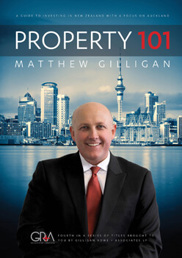
If you want to know how to invest in residential property in a way that maximises your chances of success and minimises risk, this is the right book for you.
Matthew Gilligan provides a fresh look at residential property investment from an experienced investor’s vi..... More
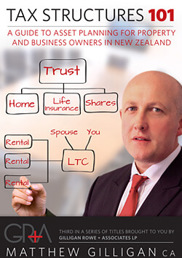
Interested in paying less tax, property investment structures, trusts and protecting your assets? This is the right book to read.
Try asking two lawyers and two accountants "How should I own my property and business assets?" You will likely get four different ans..... More
Insurance is a necessary part of mitigating risk – both for your properties and for yourself personally. GRA recommend these insurance providers. Contact them to find out more and to get no-obligation quotes.
Learn more and get an instant quote

For a free risk assessment visit www.riskdirect.co.nz

 Free Resources, Tools & Downloads
With Salesh Chand and Kris Pedersen

With Matthew Gilligan, August 2026

How to build a portfolio, August 2026

Costs, AI, Clients, Hiring, Banking - July 2026

Properties we’d never touch Webinar June 2026

Steve Goodey & Matt Gilligan Talk Strategy, June 2026

With Salesh Chand and Kris Pedersen, March 2026

With Salesh Chand December 2025

With Salesh Chand & Kris Pedersen

With Salesh Chand - Oct 2025

With Salesh Chand - July 2025

With Salesh Chand, June 2025

with Matthew Gilligan and Tony Alexander

How to use residential property to help provide for retirement
With Matthew Gilligan and Steve Goodey, March 2025
Webinar with Matthew Gilligan and Kirsty Merriman. Nov 2024

With Matthew Gilligan and Steve Goodey August 2024

Market insights with Matthew Gilligan, Kris Pedersen, Anthony Lipscombe, and Tony Alexander - June 2024
Preparing for the end of the financial year, March 2023

Tax Changes & Property Market Update 27 Oct 2021 Webinar

Matthew interviews David Seymour, April 7 2021

Impact of Bright-line & Interest Deductibility Changes, March 2021
Webinar with John Rowe August 2020
The importance of good property education

Discover how to start and succeed in property investing

Arrange to meet in-person or online to discuss your affairs
With respect to the various resources available from our website, neither Gilligan Rowe & Associates LP (“GRA”), nor its owners nor any of its employees, make any warranty, express or implied, including warranties of merchantability and fitness for a particular purpose, or assume any legal liability or responsibility for the accuracy, completeness, or usefulness of any information, product, or process. GRA will not be liable for any problems or damages of any kind experienced by users of GRA’s online materials, resources or tools. The information and resources from or through this site are provided “as is,” “as available,” and all warranties express or implied, are disclaimed. The information or tools may contain errors, problems or other limitations. Our sole and entire maximum liability for inaccurate information, for any reason, and the user's sole and exclusive remedy shall be limited to the amount paid for the information, tool or other resource (if any). GRA are not liable for any indirect, special, incidental or consequential damages whatsoever.