Labour’s Capital Gains Tax Policy: Well-Intentioned, Deeply Flawed
6247POSTED:

Articles by Matthew Gilligan.

On 5 May I appeared on TVNZ alongside economic commentator Bernard Hickey to discuss Labour’s proposed capital gains tax (CGT) policy. You can watch the interview at the bottom of this blog.
Let me say upfront: I agree that a capital gains tax can be fair and equitable – but only if it is designed around best-practice principles. The concept is sound. Labour’s execution is not.
We already have a form of CGT through our bright-line rules, and there are genuine structural arguments for going further. My problem is not with the idea of taxing capital gains. My problem is with Labour’s specific proposed policy. As it stands, it fails three fundamental tests of good tax design, and until those are addressed, I cannot support it.
The most glaring problem with Labour’s CGT is that it makes no adjustment for inflation. Without indexing, the tax is not just taxing gains – it is taxing capital itself. That is not a CGT in any meaningful sense; it is a capital erosion tax dressed up as something fairer.
Consider the numbers. Between October 2020 and October 2025, house prices rose just 10%, while inflation ran at 25%. Under Labour’s policy, an investor who sold a property over this period would be taxed on a nominal gain of 10%, despite having made a real capital loss of 15%. The government would be taxing money that never actually existed in real terms.
Australia has had a CGT since the late 1980s. They grasped this problem early: once you’ve owned an asset for more than 12 months, you’re only taxed on 50% of the nominal gain, partly as a concession to inflation. It is not a perfect solution, but it is an honest attempt to keep the tax fair. Why is Labour not starting there, rather than reinventing the wheel with a policy that taxes illusionary gains?
A well-designed CGT should not skew capital behaviour; it should be neutral across asset classes, taxing gains wherever they arise. Labour’s proposed policy does the opposite. It is a rifle tax, targeting property while leaving business sales and share portfolios largely untouched.
If Graeme Hart sells a multi-billion dollar business and pockets a $3 billion capital gain, that would not be taxable under this policy. But a landlord selling a rental property for a $200,000 gain would be. Someone making $200,000 on a share portfolio escapes. The property investor does not. That is not equity; it is arbitrary discrimination between asset classes.
When you tax one class of investment but not others, money does not flow to where it is genuinely needed. Instead of capital following real economic signals, like low yields indicating a surplus of housing supply, it chases tax advantages. Investors simply move into shares or business assets to avoid the rifle. That is classic tax-distorted capital allocation, and it is bad policy.
Labour proposes taxing all capital gains at a flat rate of 28%, aligned to the corporate tax rate. The effect is deeply regressive. Consider two scenarios: someone earning $50,000 a year who makes a $50,000 capital gain, and a high-income earner on $500,000 who makes the same $50,000 gain. Under Labour’s policy, both pay 28%. That is plainly unfair.
The low-income earner should be taxed at their marginal rate — around 10.5% on a gain of that size. The high-income earner should pay 39%. To avoid distorting investment by entity type, the rate should also reflect the nature of the taxpayer: an individual at their marginal rate, a trust or company at its applicable rate. Apply a discount or indexation for tenure on top of that, and you have something that is genuinely fair, progressive, and not punishing to ordinary New Zealanders.
Australia taxes capital gains at the seller’s marginal rate and offers a 50% discount for assets held more than 12 months. It is not perfect, but it is simple, provides meaningful inflation relief, and does not punish low-income earners with a corporate-rate tax bill.
Beyond the structural flaws, Labour’s CGT would generate two well-documented unintended consequences seen in other jurisdictions.
The first is the lock-in effect. When a CGT is triggered on sale, property owners avoid selling. Instead, they borrow against accumulated gains, deferring the tax event indefinitely. This reduces market liquidity and can entrench ownership across generations – the very opposite of what a CGT aimed at fairness should achieve.
The second is the “mansion effect”. Because private homes are largely exempt, the policy creates a powerful incentive to concentrate wealth in a single expensive owner-occupied property rather than spreading it across multiple investment properties. Rather than owning ten rental properties worth $10 million in total and providing housing for ten families, the tax code encourages putting that $10 million into one exempt family home. The result is less rental supply, driven not by genuine market forces, but by tax distortion. Bernard Hickey has proposed a land tax on all land as a remedy for this. He may well be right about the economic logic but that is a debate for another day.
There is a broader context that makes all of this more urgent. Labour is also signalling a partial return of interest non-deductibility rules for landlords, with around 50% non-deductibility being floated. Combine a CGT on unadjusted nominal gains with the denial of deductions for the primary cost of holding a property – interest – and you make residential property investment genuinely un-investible for many landlords.
The numbers matter here. There are approximately 512,000 rental dwellings in New Zealand, and about 75% of landlords own just one property. These are not corporate investors; they are everyday New Zealanders who have built property into their retirement plan. If Labour’s combined policy settings push even a fraction of them out of the market, the consequences are predictable:
The total residential market is worth around $1.2 trillion. Roughly $800 billion of that is owner-occupied housing, largely exempt from this CGT. Two-thirds of the housing market goes untaxed. This is not the broad structural reform its advocates claim.
Here is the irony at the heart of this policy: after all the disruption it would cause, Labour’s CGT is unlikely to generate significant tax revenue. Bernard Hickey and I agreed on this point during the interview, which should give Labour serious pause.
The reason comes down to what actually makes up New Zealand’s private rental market. The bulk of investor-owned properties are not large standalone homes with substantial capital growth. They are small townhouses – the so-called “shoeboxes” built in volume over the past decade under intensification rules including the Unitary Plan and the MDRS. These properties exist in an oversupplied market. Densification has produced a vast increase in rental stock at precisely the same time that immigration has slowed. The result is minimal capital growth. In some pockets, values have gone backwards.
Meanwhile, the $800 billion of owner-occupied housing, where the real wealth accumulation has happened, sits outside the tax net. Labour is essentially designing a tax around the least-valuable, lowest-growth, least-frequently-traded segment of the property market. The revenue projections, particularly in the first several years, would be modest at best. It is significant political pain and market disruption for a policy that will not deliver meaningful fiscal returns.
If the goal is genuinely a fairer tax system, there is a simpler and lower-risk path available.
The bright-line test is already a CGT in all but name, and it already uses the taxpayer’s native tax rate — the individual’s marginal rate, or the applicable entity rate for trusts and companies. It is already progressive. Extending it to 20 years would achieve most of what a new CGT is intended to do, without requiring the valuation of 512,000 rental properties plus commercial property as at July 2027, and without triggering the distortions and compliance burden a new regime would bring. Pair that with inflation indexing of the cost base, and you have something that is fair, equitable, simple, and not punishing to lower-income New Zealanders.
If Labour genuinely wants a full CGT, then do it properly: apply it to all asset classes equally — property, shares, and business — inflation-adjust the gains, and tax at marginal or entity rates rather than a flat 28%. Australia has been running a version of this for nearly four decades. The blueprint exists. Use it.
I want to be clear: I have no objection to people paying their fair share of tax. If a well-designed CGT achieves that, I can support it. What I cannot support is a policy that taxes inflation as if it were a gain, discriminates arbitrarily between asset classes, and charges low-income earners at the same rate as corporations.
Labour’s CGT policy, as proposed, is severely flawed – the product of inadequate consultation and a failure to apply international best practice. Sixty-one percent of New Zealanders, according to recent polling, already believe the policy is poorly designed, specifically citing the inflation problem. Governments around the world have learned at the polls that poorly designed CGT regimes are politically toxic, and for good reason.
New Zealand deserves a tax system that is fair, equitable, transparent, and simple. Labour has not hit the mark. Extend and index the bright-line rules if the goal is taxing property gains. Or go further and design a proper CGT that treats all asset classes evenly, uses marginal rates, and adjusts for inflation. Either would be defensible. What is currently on the table is not.
Apologies for the poor video/sound quality.


We enjoyed everthing about Property School. Every night was hugely valuable and inspiring. We went away energised. - Roz C - September 2017
Investing in residential property?
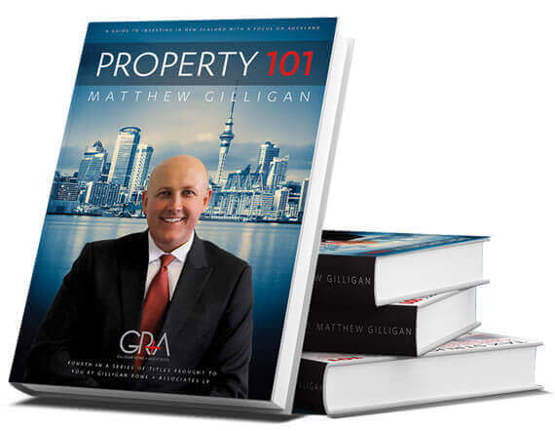
If you're investing in residential property, seeking to maximise your ability to succeed and minimise risk, then this is a 'must read'.
Matthew Gilligan provides a fresh look at residential property investment from an experienced investor’s viewpoint. Written in easy to understand language and including many case studies, Matthew explains the ins and outs of successful property investment.









 Free Resources, Tools & Downloads