Articles by Matthew Gilligan.

The long awaited new associated persons rules have finally passed into law. On 6 October 2009 the legislation received Royal Assent. The new rules apply to land acquired on or after 6 October and in certain instances to improvements made to buildings after that date. More on that later, but to begin let's briefly revisit what these rules are about.

In the context of land transactions, up until now, it has been possible to arrange your affairs so that if you wanted to carry out property dealing/development or building activity you could separate this from your investment properties and prevent the former from tainting the latter. The IRD have long seen this as a weakness in the legislation and a loophole, and for the last couple of years have been pushing for reforms to be enacted. The end result is that there is a new series of associated persons tests that are extremely comprehensive.
They include new tests that associate two trusts, new wider tests to associate two companies and companies to shareholders and a tripartite test whereby two parties can be deemed to be associated, even though not directly associated to each other, but where they have a common party to which they are both associated. Where a property is tainted, a gain that otherwise would not be subject to income tax, is subject to income tax if sale occurs within 10 years of acquisition (or in some instances within 10 years of completion of improvements).
The new association rules are so comprehensive that if you are engaged in the business of property dealing or development and you wish to acquire an investment property post 6 October 2009, it is highly likely that the property will be tainted. In fact the rules are designed to be so comprehensive that it is likely that the IRD would view any attempt to structure around them as tax avoidance. That being the case, if you currently run property dealing and development activity via a trading trust for example, it might be tempting to wind up the trust and trade via a different structure, but in our view this might be “throwing the baby out with the bath water”. That is, while a trading trust might not necessarily prevent association anymore, it does not follow that it is automatically the wrong structure. There are other beneficial aspects of using trading trusts, such as flexibility in distributing income and good asset protection.
Another aspect of tainting that taxpayers need to bear in mind is that the association to the property dealer or developer has to exist on the day that the investment property (that you do not wish to be tainted) is acquired. Taxpayers who cease their property dealing and development activity no longer have a tainting issue and can then acquire rental property free of tainting risk. This means if you have entities that have been involved in these types of business in the past, you should consider winding them up to cease any tainting risk.
We also note that you have to be engaged in a business of property dealing and development. There may be instances where somebody has conducted one or two property trade transactions but is not necessarily engaged in a business such that they would have a tainting risk.
Finally, you should also recognise that even under the new comprehensive association rules, the 10-year test still applies. This means in a worst case scenario where a property is acquired and tainted as a result of association to a property dealer or developer, you can still break the tax impact of tainting by holding the property for 10 years. As a technical point, you should note that if you are in the business of erecting buildings then tainting only applies if you make improvements to the rental property, but then applies to sale within 10 years of completing the improvements.
The moral of the story is if you are acquiring property or just concerned about the impact of these new tainting rules on you, you should seek advice. Please contact us at [email protected], phone +64 9 522 7955 or via our website to discuss.

Prompt, polite and friendly, competent.
- Penny Darwin, February 2024

Gilligan Rowe and Associates is a chartered accounting firm specialising in property, asset planning, legal structures, taxation and compliance.
We help new, small and medium property investors become long-term successful investors through our education programmes and property portfolio planning advice. With our deep knowledge and experience, we have assisted hundreds of clients build wealth through property investment.
Learn More


Meet with one of our senior property consultants to discuss your long-term plans for property investment and formulate a strategy for achieving them.
We offer both online and in-classroom education to help you move forward with your property investing.
Wealth Suite is a powerful online learning, analysis, planning and forecasting resource. There are four key components, and you can choose to use one, some or all of them.
• Cash flow analysis for home, property and business • Overview of total equity, debt and market value of assets • Analysis of home expenses and income
• Set retirement goals. • Analyse when you will be able to retire based on your current path. • Input 'what if' scenarios and see how they impact when you will reach your goals (e.g. what if I buy two investment properties in the next five years?)
Property analysis calculators for current and future investments, including: • Trade (flip) • Buy-to-hold• Subdivision• Land banking• Houses of multiple occupancy (HMOs).• Due diligence tool
Videos, articles and quizzes related to
property taxation, and asset protection
to further your education
If you are new to Gilligan Rowe & Associates, we can offer you a free initial meeting with a senior consultant to review your current structure and discuss your accounting needs. In this meeting we will discuss ways to optimise tax and protect your assets so you are in the best position going forward.
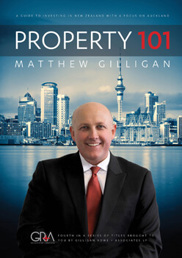
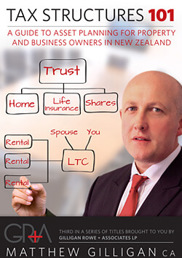
Written by GRA managing director Matthew Gilligan, we offer two books:
If you want to know how to invest in residential property in a way that maximises your chances of success and minimises risk, this is the right book for you.
Matthew Gilligan provides a fresh look at residential property investment from an experienced investor’s vi..... More
Interested in paying less tax, property investment structures, trusts and protecting your assets? This is the right book to read.
Try asking two lawyers and two accountants "How should I own my property and business assets?" You will likely get four different ans..... More
Insurance is a necessary part of mitigating risk – both for your properties and for yourself personally. GRA recommend these insurance providers. Contact them to find out more and to get no-obligation quotes.
Learn more and get an instant quote
For a free risk assessment visit www.riskdirect.co.nz

With Salesh Chand and Kris Pedersen, March 2026
With Salesh Chand December 2025
With Salesh Chand & Kris Pedersen
With Salesh Chand - Oct 2025
With Salesh Chand - July 2025
With Salesh Chand, June 2025
with Matthew Gilligan and Tony Alexander
How to use residential property to help provide for retirement
With Matthew Gilligan and Steve Goodey, March 2025
Webinar with Matthew Gilligan and Kirsty Merriman. Nov 2024
With Matthew Gilligan and Steve Goodey August 2024
Market insights with Matthew Gilligan, Kris Pedersen, Anthony Lipscombe, and Tony Alexander - June 2024
Blandon Leung of MortgageHQ interviews Matthew Gilligan, May 2024
Webinar with Matthew Gilligan and Steve Goodey, February 2024
Ryan Melton of NZ Business Owners Podcast interviews Matthew Gilligan
Blandon Leung of MortgageHQ interviews Matthew Gilligan, November 2023
Matthew Gilligan interviews National’s Paul Goldsmith and Chris Bishop about National’s proposed policies, September 2023
Matthew Gilligan interviews David Seymour about Act’s proposed policies, September 2023
Matthew Gilligan and Kris Pedersen discuss finance for property investors, August 2023
Preparing for the end of the financial year, March 2023
Tax Changes & Property Market Update 27 Oct 2021 Webinar
Matthew interviews David Seymour, April 7 2021
Impact of Bright-line & Interest Deductibility Changes, March 2021
Webinar with John Rowe August 2020
The importance of good property education
Discover how to start and succeed in property investing
Arrange to meet in-person or online to discuss your affairs
With respect to the various resources available from our website, neither Gilligan Rowe & Associates LP (“GRA”), nor its owners nor any of its employees, make any warranty, express or implied, including warranties of merchantability and fitness for a particular purpose, or assume any legal liability or responsibility for the accuracy, completeness, or usefulness of any information, product, or process. GRA will not be liable for any problems or damages of any kind experienced by users of GRA’s online materials, resources or tools. The information and resources from or through this site are provided “as is,” “as available,” and all warranties express or implied, are disclaimed. The information or tools may contain errors, problems or other limitations. Our sole and entire maximum liability for inaccurate information, for any reason, and the user's sole and exclusive remedy shall be limited to the amount paid for the information, tool or other resource (if any). GRA are not liable for any indirect, special, incidental or consequential damages whatsoever.