Can you still create equity in property in a flat market?
6641POSTED:
0
Views

Articles by Salesh Chand.

Yes, you can still create equity in property, even in a flat market with an election around the corner. You just can’t rely on rising prices to do it for you. Over the past six months, I’ve watched clients create around $2.7 million of equity across six deals by doing three things well: getting the numbers right before they signed anything, buying at the right price, and adding value to what they bought.
In our recent webinar, The Proof Is in the Property: Creating Equity in an Election Year, Maggie Zabaglo, Than Sundar and I took viewers through those deals step by step. This article covers the key points, including what to look for when you buy, where the discounts are, which renovations pay off, and how to position your portfolio whatever the election result.
You can watch the full webinar here or at the bottom of this article.
A quick note before we start: Maggie, Than and I are not financial advisers. This is general information only, so please get advice for your own situation before making investment decisions.
The market has gone flat, but there is more money sitting on the sidelines than I’ve ever seen. Experienced investors have overdraft facilities, offset accounts and cash ready to go, and they are all looking for deals. Traders are active because funding is easy to get, and banks have relaxed their lending to investors.
At the same time, several things are holding buyers back: pre-election uncertainty, higher fuel prices from the conflict in the Middle East, and a share market that has knocked some investors’ confidence. I’ve had clients tell me they wish they’d left their money in property or in the bank.
That combination makes it a buyer’s market in many areas. We’re seeing plenty of supply in:
For long-term investors, it’s a good time to buy. Tenant demand stays strong for good properties, and in New Zealand a good property usually means one with a car park, ideally two.
Working capital is the cash or credit you can draw on at any time. Without it, even a family with millions in assets can feel under pressure every week.
In the webinar, I showed an example family with a $2 million home, a $1.5 million business, a $900,000 bach and $1 million of investment property. They had only $50,000 of working capital. With the same assets, but $540,000 available through overdrafts, offset facilities and credit cards, the money pressure disappears.
Most people say, “But I’ll never use it.” That’s the point. If the business needs $200,000 for a few months, or the market turns, you don’t have to beg anyone for money or fire-sell an asset.
It took me nearly four years to set this up across my own portfolio, and it’s the reason I can now act quickly when a deal comes up. I covered more on managing cash flow in a tough market in my Surviving and Growing in a Slow Economy blog, which you can read here (it also has a link to the webinar on the same topic).
These six deals were all done by GRA clients within the past six months, and they’ve given us permission to share them. Three are long-term holds and three were sold.
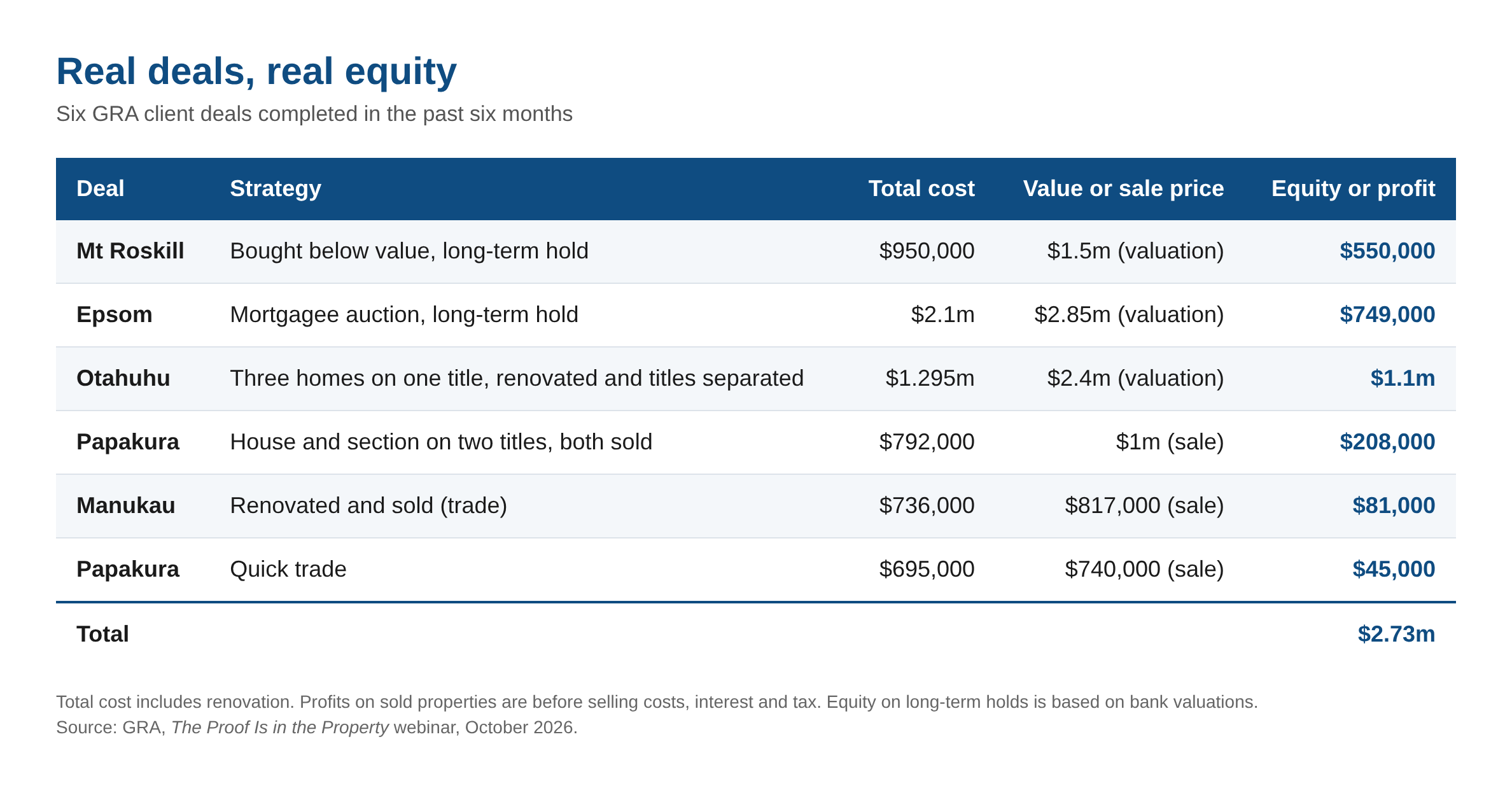
The Otahuhu deal is a good example of what’s possible. The client bought three homes on one title at auction for $1.085 million and spent around $210,000 on renovation and separating the titles. After about eight weeks of work, it was valued at $2.4 million. He’s keeping all three and renting them to a social housing provider.
The Mt Roskill client also has room for three more dwellings on the site. Because the bank valuation has created equity, he can refinance to fund them over time, without putting in more of his own cash.
Buying well comes down to two things: location and property type. Get these right and you set yourself up for strong tenant demand and long-term growth.
Location:
Property type:
Buying at a discount gives you equity on day one. As the saying goes, you make your money when you buy. Here’s a simple example from a client Maggie helped:
The client can refinance and use that equity towards the next property, rather than saving another deposit. My first deal in 2010 created $40,000 of equity, and it felt like winning Lotto because it let me buy my second property.
The places we’re seeing discounts right now are:
Whatever the situation, ask the agent why the vendor is selling. It tells you how much room there is to negotiate.
The renovations that add value are usually the cheaper, cosmetic ones that make a good first impression. As Than pointed out, buyers judge a property from the street, so don’t leave the outside until last.
Work that adds value:
Work that can just cost money:
These can add value, but often less than they cost. If a property needs this kind of work, you need to buy at a price low enough to cover it.
Than and I learned this the hard way on a project in New Lynn. We replaced the windows with double glazing and turned the house into a Taj Mahal, spending about $170,000. The market would only pay $820,000, and we made just $10,000 to $15,000 after months of work. We could have spent $60,000 and made the same or more. Nobody walked in and looked at the windows.
Every area has a price ceiling. On a $700,000 house, a $20,000 kitchen won’t get you $720,000. The same goes for rentals: tenants won’t pay $50 more a week because you replaced carpet they never complained about.
If you’re building a long-term portfolio, a big empty lawn isn’t earning you any rent. Adding a dwelling can lift your yield and create equity from land you already own.
One minor dwelling (granny flat) of up to 70 square metres can now be added to most sites without a building consent or resource consent, as long as it’s properly designed, built by licensed professionals, and notified to council. If you want to go further, many zones, especially in Auckland, also allow several dwellings on one site without subdividing, although these need the usual consents. Check the rules for your property with council first.
As Maggie explained, whether to subdivide depends on your goals:
Whatever you do, cost it fully, check zoning, contributions and services, and make sure you can fund it and hold it. If you’re thinking about a bigger project, our Property Development School and free e-book on property development and tax are good places to start.
The basic equation is simple: value on completion minus total cost equals equity created. On the Otahuhu deal, that was $2.4 million minus $1.295 million, which is $1.105 million of equity.
Where people go wrong is underestimating the total cost. Make sure yours includes:
Interest is the thing people tend to forget. If a project runs over and your loan moves to a default rate, your equity can disappear quickly. Have a refinancing plan in place in case things take longer than expected (see Should You Fix, Refinance or Wait?). Most of all, keep emotion out of it. If the project costs as much as the finished property is worth, you won’t be able to refinance.
We’ve learned some lessons the hard way. We’ve gone over our 10% contingency on almost every project we’ve finished. Delays and red tape from service providers are usually the cause. More recently it has also been because of the problems in the Middle East affecting oil prices, and the cost of materials increasing, both beyond our control.
On one project, sorting out a power line with the network company took nearly three years, cost us around $480,000, and nothing about the power line actually changed.
Our main lessons are:
The main parties have now set out their positions on property tax, and both outcomes leave room to keep investing. Here’s a summary of what has been announced.
If Labour leads the next government:
If the current government is re-elected:
In my opinion, every property investor should be voting for ACT. I really like the ring-fencing policy, and not because it keeps accountants busy. It lets young people get into property investing. Tax incentives are what got me started, and we need to give young people a reason to stay in New Zealand rather than heading to Australia for the tax advantages.
These are party proposals, not law, and the details may change after the election. Whatever happens, don’t let politicians drive your investment decisions. If you’d like to know how either outcome could affect your own position, our property tax structures team can help.
The good news is that the same approach works under either outcome:
My advice hasn’t changed in 10 years. Don’t do nothing, and don’t use lack of time or fear as an excuse. Set yourself a timeline with targets, surround yourself with the right people, and think long term.
If you’d like help reviewing a deal, setting up working capital, protecting your assets or positioning your portfolio for after the election, our team can talk it through with you. The initial meeting is free for new clients. Request a meeting, or call 09 522 7955 and ask for Aimee.
To learn the full process, from buying well to growing your portfolio, take a look at GRA Property School, our online, on-demand course.
Watch the full webinar below
Maggie, Than and I go through every one of the deals in more detail in the full webinar, along with questions from viewers.


We were about to subdivide our section and needed property tax advice. Googled "who's any good" and GRA were in the top 3 on a few sites that recommended providers. We worked with Anthony Lipscombe. Very easy to deal with, comprehensive chat/ conversation that led to a written report by Anthony where his thinking was sharp, clearly communicated, coming at aspects from multiple points of view. i.e. he took time to make sure the reader (my wife and I) completely understood (in plain English) what he was saying. Highly recommended.
- Jason C, October 2023


Gilligan Rowe and Associates is a chartered accounting firm specialising in property, asset planning, legal structures, taxation and compliance.
We help new, small and medium property investors become long-term successful investors through our education programmes and property portfolio planning advice. With our deep knowledge and experience, we have assisted hundreds of clients build wealth through property investment.
Learn More








 Free Resources, Tools & Downloads